Health Data, AI and New Digital Laws: Germany Is Now Laying the Groundwork for Data-Driven Medicine

Panel discussion “How Can Sustainable Innovation Transfer Succeed? From Proof of Concept to Impact” (from left to right): Dr. Markus Müschenich (Heal Capital), Prof. Dr. Surjo R. Soekadar (Charité – Universitätsmedizin Berlin), Dr. Kathrin Haubold (BIH at Charité, panel moderator), Fabian Queisner (Nuuron GmbH) and Dr. Janna Hachmann (Captain T Cell GmbH). © TMF e.V.
Health data are considered key to medical innovation, improved healthcare and the development of new therapies. However, whether Germany can harness this potential depends not only on technological capabilities. The European Health Data Space (EHDS) and new digital legislation are currently shaping the key framework conditions for health research in the years to come. These issues were discussed by experts from academia, politics, healthcare and industry at the 17th TMF Annual Meeting, held in Berlin on 16 June 2026 under the theme “Data Powers Science: Turning Data-Driven Research into Innovation.”

TMF Executive Director Sebastian C. Semler. © TMF e.V.
“Germany has outstanding researchers, high-performing research institutions and an innovative healthcare industry. For them to realise their full potential, we need access to health data and reliable frameworks for its use,” said TMF Board Chair Prof. Dr. Rainer Röhrig at the opening of the congress, attended by around 200 experts in Berlin. “With the new digital policy legislation in the healthcare sector, key building blocks for a modern health data and healthcare delivery architecture are now on the table. The parliamentary process will determine whether these elements come together to form a coherent overall system that effectively integrates data access, healthcare management and research,” emphasised Sebastian C. Semler, Executive Director of the TMF.
European Health Data Space: Connecting Health Data Across Europe
The European Health Data Space (EHDS) establishes, for the first time, a Europe-wide framework for the use of health data in healthcare and research. Participants agreed that the EHDS offers significant opportunities for science, the healthcare industry and patients alike. For Germany to realise the benefits of the EHDS, health data infrastructures must now be systematically further developed and connected at both national and European levels. “With the draft Act on Data and Digital Innovation in Healthcare (GeDIG), we are proposing a concrete health data governance framework for implementing the EHDS,” explained Nick Schneider from the German Federal Ministry of Health at the congress.

Nick Schneider, Head of Division 511 for Fundamental Issues in New Technologies and Data Use at the Federal Ministry of Health (BMG). © TMF e.V.
With the draft Act on Data and Digital Innovation in Healthcare (GeDIG), we are proposing a concrete health data governance framework for implementing the EHDS.
Without Standards, Neither AI nor Precision Medicine
A central theme of the congress was how health data can be described and structured to make them usable for research and healthcare. In his keynote, Prof. Peter N. Robinson from the Berlin Institute of Health (BIH) at Charité demonstrated why standardised phenotype data are essential for AI applications, genomic diagnostics and precision medicine. The discussion highlighted a key challenge: it is not the volume of data that poses the greatest obstacle, but rather their interoperability and semantic interpretability.
Linking Data, Generating Insights
Researchers see significant potential in the secure linkage of data from different health data sources. Data linkage is considered essential for addressing complex questions relating to care pathways, prevention, rare diseases and personalised therapies. Achieving this requires workable legal frameworks, trustworthy governance structures and technical solutions that reconcile data protection with data use. “Data trusteeship and data governance are not burdensome requirements, but enablers of an efficient and effective research infrastructure,” explained Prof. Dr. Fabian Prasser from the Berlin Institute of Health (BIH) at Charité.

Prof. Dr. Fabian Prasser, Scientific Director of the Medical Data Integration Center (MeDIC), Berlin Institute of Health (BIH) at Charité. © TMF e.V.
Data trusteeship and data governance are not burdensome requirements, but enablers of an efficient and effective research infrastructure.
From Research to Healthcare
Another key focus of the congress was how scientific findings can be translated into healthcare more quickly. Participants emphasised that Germany has excellent research infrastructure, yet innovations often take too long to reach clinical practice. The panellists agreed that data-driven research must be more closely integrated with real-world healthcare, regulatory processes and innovation funding.
Digital Legislation Must Enable Innovation
In the closing panel, representatives from academia, politics and healthcare discussed current legislative initiatives. There was broad agreement that the new laws represent important milestones. However, their impact will ultimately depend on whether they facilitate access to health data, accelerate research, and at the same time ensure trust and data security.
Clear political prioritisation of harmonisation, interoperability and the practical use of data is needed to ensure that Germany keeps pace with the EHDS and fully harnesses the opportunities offered by data-driven, learning healthcare systems.
The draft bills on data and digital innovation in healthcare (GeDIG), research data (FDG), medical registries (MRG) and emergency care reform provide key building blocks for data access, healthcare management and research infrastructure. “A key priority for Germany as a hub for innovation is that the Research Data Act must finally be enacted and genuinely enable research using linked data,” emphasised Dr. Andrea Lübcke, Member of the German Bundestag (Alliance 90/The Greens).

Dr. Andrea Lübcke, Member of the German Bundestag (Alliance 90/The Greens). © TMF e.V.
“The GeDIG is intended to significantly improve the use of health data for research, innovation and healthcare,” emphasized Matthias Mieves, Member of the German Bundestag (SPD). “The GeDIG is one of the most important pieces of legislation for the future of medicine in this legislative term and a clear signal that Germany is now consistently advancing the digitalization of its healthcare system,” said Dr. Thomas Pauls, Member of the German Bundestag (CDU/CSU). “The feedback from practitioners on the draft bill is constructive and highlights where there is still room for further development. That is precisely what the parliamentary process is for. I look forward to the deliberations and to continuing the dialogue with stakeholders from research and healthcare.”

From left to right: Sebastian C. Semler (Executive Director of TMF), Dr. Frank Wissing (Medical Faculty Association), Dr. Andrea Lübcke, Member of the German Bundestag (Alliance 90/The Greens), Dr. Alexandra Ramshorn-Zimmer (Leipzig University Hospital), Prof. Dr. Rainer Röhrig (Chair of the TMF Board | RWTH Aachen University) and Nick Schneider (German Federal Ministry of Health). © TMF e.V.

TMF Chair Prof. Dr. Rainer Röhrig and Dr. Doris Meder, Administrative Director of the Berlin Institute of Health (BIH) at Charité, opened the 17th TMF Annual Meeting. © TMF e.V.

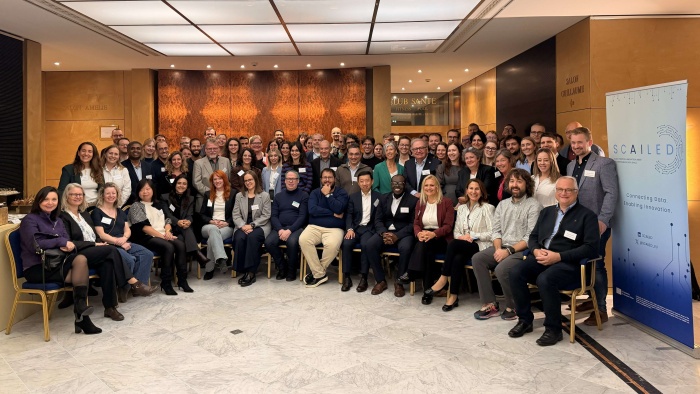
Around 200 experts met in Berlin on 16 June 2026 for the 17th TMF Annual Meeting. © TMF e.V.

The 17th TMF Annual Meeting was held in Berlin for the first time this year. The venue was the Kaiserin Friedrich Foundation. © TMF e.V.
About the TMF Annual Meeting
The 17th TMF Annual Meeting took place on 16 June 2026 in Berlin. It was organized by TMF in collaboration with the Berlin Institute of Health (BIH) at Charité and the German Rheumatology Research Center (DRFZ).
Press Contact
Wiebke Lesch
Tel.: +49 30 2200 24731
Mobile: +49 177 2663257
Email: presse@tmf-ev.de
Further Information
About TMF e.V.
The TMF – Technology, Methods, and Infrastructure for Networked Medical Research e.V. stands for research, networking, and digitalization in medicine. It is the umbrella organization for collaborative medical research in Germany, within which top researchers exchange knowledge, work together to develop ideas and concepts, and thus shape the future of medical research in the digital age.