4th genomDE Symposium 2025: “We Are on the Verge of an Innovation Leap in Genomic Medicine”

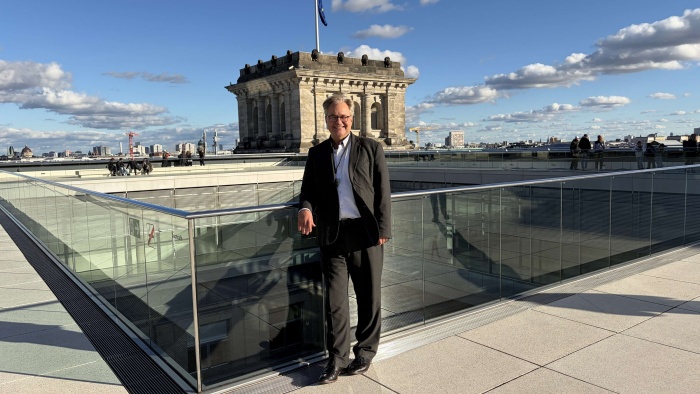
Dr. Georg Kippels, Parliamentary State Secretary at the Federal Ministry of Health, and Sebastian C. Semler, Executive Director of TMF. © TMF e.V.
At the genomDE Symposium, held on 10 and 11 July 2025 in Berlin, the successful launch of the Genome Sequencing Model Project was the main focus. In his keynote opening the symposium, Dr. Georg Kippels, Parliamentary State Secretary at the Federal Ministry of Health, emphasized: “Over the next five years, we expect 100,000 patients to be included in the Genome Sequencing Model Project.” The shared goal of the model project is to help people and make the benefits of the National Strategy for Genomic Medicine available to patients.
The genomDE Symposium has developed into one of the most important events for the genomic medicine community in Germany, providing a forum for numerous leading representatives from clinical practice, research, medical informatics, networks, projects and health policy. This year, it is organised by the TMF – Technology, Methods, and Infrastructure for Networked Medical Research e.V., together with the Federal Institute for Drugs and Medical Devices (BfArM), the German Human Genome-Phenome Archive (GHGA) and the German Network for Bioinformatics Infrastructure (de.NBI/ELIXIR-DE).
The genomDE Symposium focuses on current genomic medicine therapies for affected patients, the development of data infrastructures in Germany and Europe, and the further advancement of personalised medicine. One of the key topics is the genomDE Model Project. Within its legally defined duration, the project aims to assess the extent to which whole-genome sequencing can improve healthcare for people with rare diseases and cancer. The findings obtained through the project may lead to improved diagnostics and alternative treatment recommendations. This requires extensive, high-quality, structured datasets, which are collected as part of the project and are included in the reimbursed services.
Sebastian C. Semler, Executive Director of TMF e.V., which coordinates the genomDE project, explained: “Genomic medicine means gaining a better understanding of the genetic causes of diseases and using this knowledge in a targeted way for diagnosis and treatment.” He emphasised that the aim is to enable personalised medicine in which treatments are tailored to the individual genetic profiles of patients.

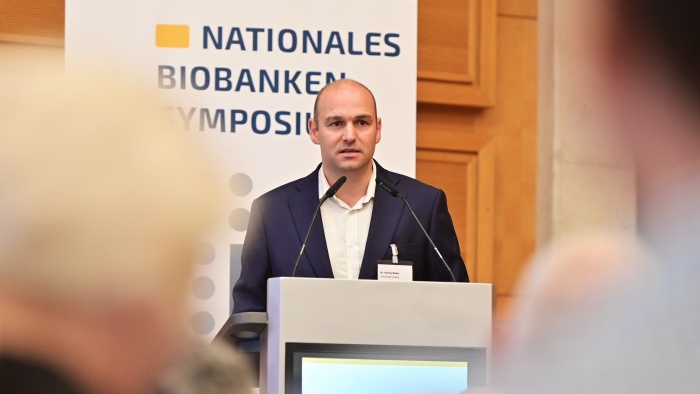
TMF Executive Director Sebastian C. Semler. © TMF e.V.
Genomic medicine means gaining a better understanding of the genetic causes of diseases and using this knowledge in a targeted way for diagnosis and treatment.
Based on the evaluation of the “Model Project for Comprehensive Diagnostics and Treatment Planning Using Genome Sequencing for Rare and Oncological Diseases” pursuant to Section 64e of the German Social Code, Book V (SGB V), genome sequencing is to be integrated into routine healthcare after the five-year project period.
“Almost 25 years after the first published version of a human genome, genomic medicine in Germany has reached an important milestone with the launch of the genomDE Model Project,” said Professor Dr. Oliver Kohlbacher from Tübingen University Hospital. “The project lays the foundation for the structured and secure use of genomic data in clinical care and research. This marks a key step towards personalised medicine in Germany, enabling more precise diagnoses and individualised treatments.”

Prof. Dr. Oliver Kohlbacher, University Hospital Tübingen. © TMF e.V.
The infrastructure established as part of the model project, with its decentralised data nodes, enables the use of genomic and clinical patient data for diagnosis, treatment and research across Germany at the national level for the first time, with as little bureaucracy as possible.
At the symposium, PD Dr. Andreas Till from the BfArM provided an update on the current status of patient enrolment and the data processing activities now getting underway as part of the genomDE Model Project. The project aims to establish and evaluate structures for diagnostics and personalised treatment planning based on patients' genomic data. Its overarching goal is to expand expertise in genomic medicine in order to improve clinical care in Germany. “The genomDE Symposium is exactly the right event to bring together everyone who wants to help shape the future of genomic medicine in Germany,” said Dr. Andreas Till.

PD Dr. Andreas Till, Federal Institute for Drugs and Medical Devices (BfArM). © TMF e.V.
About the Genome Sequencing Model Project
The Genome Sequencing Model Project (officially titled “Model Project for Comprehensive Diagnostics and Treatment Planning Using Genome Sequencing for Rare and Oncological Diseases” pursuant to Section 64e of the German Social Code, Book V [SGB V]) is a key component of the National Strategy for Genomic Medicine and will help integrate genomic medicine into healthcare in Germany.
Detailed information on the Genome Sequencing Model Project is available from the BfArM here.
Impressions

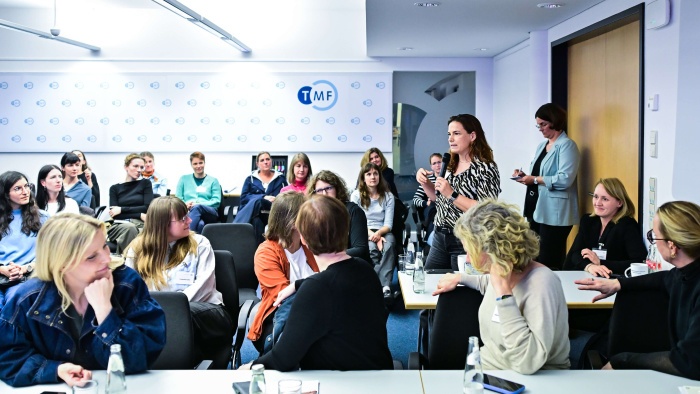
The evening event was sponsored by the German Association of Research-Based Pharmaceutical Companies (vfa) and the VDGH – Association of the Diagnostics Industry. © TMF e.V.

© TMF e.V.

Dr. Dorothee Andres, Federal Ministry of Health. © TMF e.V.
© TMF e.V.
Press Contact
Isabel Merchan
TMF – Technology, Methods, and Infrastructure for Networked Medical Research e.V.
Press and Public Relations – genomDE
Charlottenstraße 42, 10117 Berlin
Phone: +49 (0) 30 − 22 00 24 769
Email: presse@tmf-ev.de
Further Information
Downloads
Session 1: Genome Sequencing Model Project: Current Status and Further Development
| Anhang | Size |
|---|---|
| PD Dr. Andreas Till (BfArM): "Das genomDE Modellvorhaben: Wo stehen wir?" | 1.42 MB |
Session 3: Clinical Perspectives of Genomic Medicine: Oncology and Rare Diseases
Session 5: No Data, No Science - Data Infrastructures Enabling Genomic Medicine
Session 6: Personalized Medicine: Unlock New Possibilities
About TMF e.V.
The TMF – Technology, Methods, and Infrastructure for Networked Medical Research e.V. stands for research, networking, and digitalization in medicine. It is the umbrella organization for collaborative medical research in Germany, within which top researchers exchange knowledge, work together to develop ideas and concepts, and thus shape the future of medical research in the digital age.