8th National Digital Health Symposium 2026
AI and Digital Sovereignty – Towards the Medicine of the Future
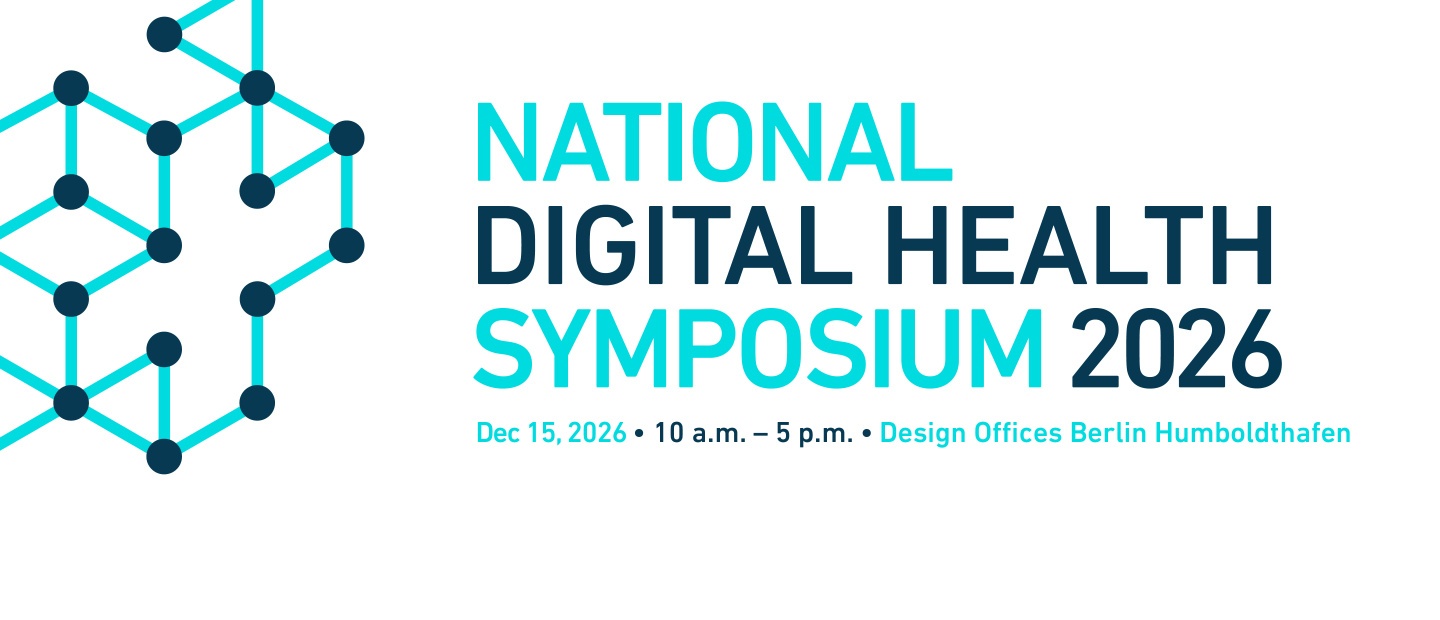
The 8th National Digital Health Symposium, organized by TMF - Technology and Methods Platform for Networked Medical Research e.V., will take place on 15 December 2026 under the theme "AI and Digital Sovereignty – Towards the Medicine of the Future." The event will be held at Design Offices Berlin Humboldthafen.
Artificial intelligence is fundamentally transforming medicine and healthcare. It is creating new opportunities for research and development, enabling more precise diagnostics, and helping to improve patient care while reducing the burden on healthcare professionals. At the same time, the growing use of digital technologies raises a key question for the future of healthcare, which will be discussed at this year’s National Digital Health Symposium: How can we harness the opportunities of digitalization while safeguarding our digital and technological sovereignty?
We are delighted to welcome you to this year’s National Digital Health Symposium.

Topic
The theme of the 8th National Digital Health Symposium is "AI and Digital Sovereignty – Towards the Medicine of the Future." Leading experts will discuss key questions, insights, and visions on how Germany can combine its strengths in medical research and healthcare with the opportunities offered by artificial intelligence and digitalization. Central to these discussions is the question of how the opportunities of digital transformation can be leveraged while at the same time safeguarding digital and technological sovereignty.

Conference
The National Digital Health Symposium organized by TMF e.V. is an annual, cross-sector forum for exchange between healthcare providers, researchers, cost bearers, industry, patients, and politics. It promotes digital cultural change in the German healthcare system with a focus on telematics, data use, AI, and regulatory developments such as the EHDS.

Organizer
The TMF - Technology and Methods Platform for Networked Medical Research e.V. stands for research, networking, and digitalization in medicine. It is the umbrella organization for collaborative medical research in Germany, within which top researchers exchange knowledge, work together to develop ideas and concepts, and thus shape the future of medical research in the digital age.
Program (as of October 15, 2026)
Tuesday
-
10:00–10:15
-
Welcome
-
10:15–10:45
-
Keynote
-
10:45–11:30
-
Session I: "Germany as a Global AI & Digital Innovation Hub: What Needs to Happen Now?"
The opening session provides an overview of the conditions needed to establish Germany as a strong hub for AI and digital innovation, with a particular focus on accelerating the translation of research into medical practice. It explores how medical research can contribute strategically to Germany’s economic strength — through sustainable value creation and the creation of highly skilled jobs. The discussion will examine the role of modern research infrastructures and reliable regulatory frameworks, as well as how to create an industry-friendly research environment that enables Germany to remain attractive to companies and investors in the global competition for innovation and investment.
-
11:30–12:15
-
Session II: "AI for More Precise Healthcare: Unlocking the Potential of Diagnostics and Precision Medicine"
The fourth session explores digitalisation as a key driver of transformation in medical diagnostics. From medical imaging to AI-powered analysis, advanced algorithms enable more precise diagnoses, faster and more individualised treatment decisions, and tailored, personalised care pathways. Smart screening approaches offer the potential to detect diseases at their earliest stages. To ensure the safe and effective translation of these technologies into clinical practice, the session will focus on methodological approaches such as federated learning, which enables privacy-preserving model training across institutional and geographic boundaries. At the same time, it will address critical challenges, including quality assurance and the prevention of bias in training data.
-
12:15–13:05
-
13:05–14:15
-
Session III: "AI in Healthcare: How Are AI Applications Advancing Care?"
The third session focuses on the practical application of AI-powered solutions, digital care services and intelligent assistance systems—from patient and care management to the integration of data from digital health applications (DiGA) and wearables into the electronic patient record (ePA). The central question is how AI-enabled healthcare and its management can be successfully implemented while combining technological efficiency with human-centred medicine. The session will also critically examine key challenges, including privacy-compliant data generation and use for research, medical liability risks, and strategies for increasing acceptance and adoption among healthcare professionals.
-
14:15–15:00
-
Session IV: "Real-World Impact of National and European Digital Legislation"
The second session focuses on current national and European legislation on digitalisation. The Act on Data and Digital Innovation in Healthcare (GeDIG), including the new Health Data Use Act (GDNG), the Medical Register Act (MRG), the Research Data Act (FDG), and the implementation of the European Health Data Space (EHDS) will be examined against the realities of real-world evidence.
-
15:00–15:20
-
Coffee Break
-
15:20–16:05
-
Session V: "How Can We Build Digital Sovereignty and Resilient Infrastructure?"
The fifth session addresses the strategic need for a resilient, sovereign and fail-safe digital health infrastructure. Against the backdrop of growing cyber threats and technological dependencies, the session will explore how health data can be used securely while unlocking its full potential for research and healthcare, how technological dependencies can be reduced, and how high-performing, interoperable infrastructures and resilient critical systems can be built. It will also discuss how Europe can strengthen its own technological capabilities without isolating itself from international innovation, and whether the European Health Data Space (EHDS), through secure data spaces, can deliver genuine digital sovereignty.
-
16:05–16:50
-
Session VI: "How Can We Drive Digital Transformation and Sovereignty in the Public Health Service?"
The final session focuses on the practical implementation of digital transformation, sovereignty and future readiness in the Public Health Service. Drawing on insights from nationwide funding programmes and concrete examples from Germany’s federal states, it examines how agile organisational structures, centrally hosted specialised applications and comprehensive training programmes can drive sustainable cultural change at the local level. A key focus is the seamless integration of the Public Health Service into the German telematics infrastructure (TI), as well as the transition from analogue document-based workflows to secure cloud architectures. The session will also explore the targeted use of dashboards and AI-powered assistant systems to significantly reduce the burden of routine tasks on healthcare professionals and strengthen the long-term pandemic resilience of public health authorities.
-
16:50–17:00
-
Closing Remarks and Conclusions
-
17:00–18:30
-
Get-together
Sponsors
![Das Logo der ]init[ AG](/sites/default/files/styles/full_small/public/images/veranstaltung-logo-init.png?itok=T4Ns9Zts "]init[ AG")


Science Year 2026
The National Digital Health Symposium 2026 is part of this year's Science Year, which is being held under the theme "Medicine of the Future."