TEHDAS2 Final Conference: The Foundation Is in Place – Now It’s Time for Implementation!

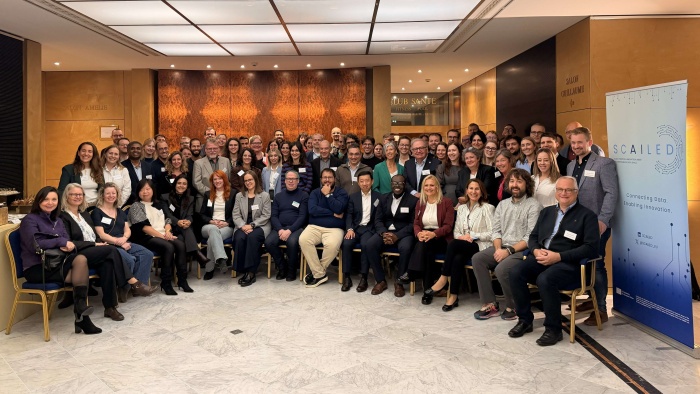
From left to right: Prof. Dr. Thomas P. Zahn (bbw University of Applied Sciences and DSI Data Science Institute GmbH), Lynn Strunk (German Association of Private Health Insurers (PKV)), Dr. Anna Niemeyer (TMF), Melanie Katterbach (PKV), Katharina Schneider (BfArM), Pia Brinkmann (Health Data Lab) and Sebastian C. Semler (TMF). © TMF e.V.
On 16 November 2026, experts from across Europe gathered in Brussels for the final conference of the EU-funded TEHDAS2 Joint Action project. TMF was also represented at the event as a project partner and took part in the ongoing discussions.

© TEHDAS2
TEHDAS2 has made an important contribution to preparing the European Health Data Space (EHDS):
A total of 21 guidelines and technical specifications on the secondary use of health data were developed as part of the Joint Action. These cover a range of topics, from identifying available data and facilitating data access to secure processing environments and safeguarding citizens’ rights.
As the EHDS draws closer, the challenges of practical implementation are increasingly coming into focus. Discussions at the conference centred in particular on the following questions: How can incentives be created for data holders, especially hospitals that are not involved in research? How can decentralised health data infrastructures be integrated into the EHDS? And how can the guidelines developed be translated into functioning national structures and processes?
Tim Hubbard (Genomics England and ELIXIR) highlighted that implementing the EHDS will pose additional challenges, particularly for countries with federated data holdings:
„SPEs are hard to build and use and expensive, but do work: there are more than 630 publications from research carried out in Genomics England’s SPE by thousands of researchers. However, in EHDS I don’t believe EU citizens will tolerate their health records moving out of national SPEs, so federation will be essential but is much harder. There are many open projects working to address this. UK has funded DARE and has a very active community - [SPEs are referred to as TREs - Trusted Research Environments]. ELIXIR has been coordinating EOSC-Entrust and GDI for B1MG which has exemplars of cross national federated analysis of genomes. If EHDS can be delivered as a federated research ecosystem it has the potential to become a global standard, just like GSM.“

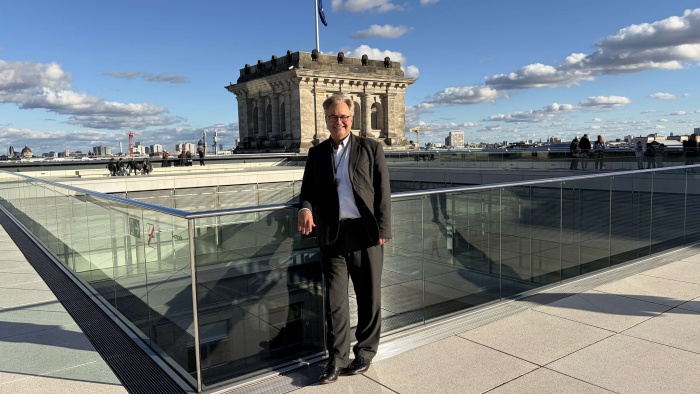
Tim Hubbard (King's College London) and Wei Gu (Luxembourg National Data Service). © TMF e.V.
The key message of the conference: Now is the time to demonstrate how the EHDS can work in practice. This will require joint efforts at both national and European level. The TMF looks forward to actively helping shape this process.

© TMF e.V.
Further Information